

Information from Bob Bowles, founder and instructor of the Master Naturalist Program through Lakehead University
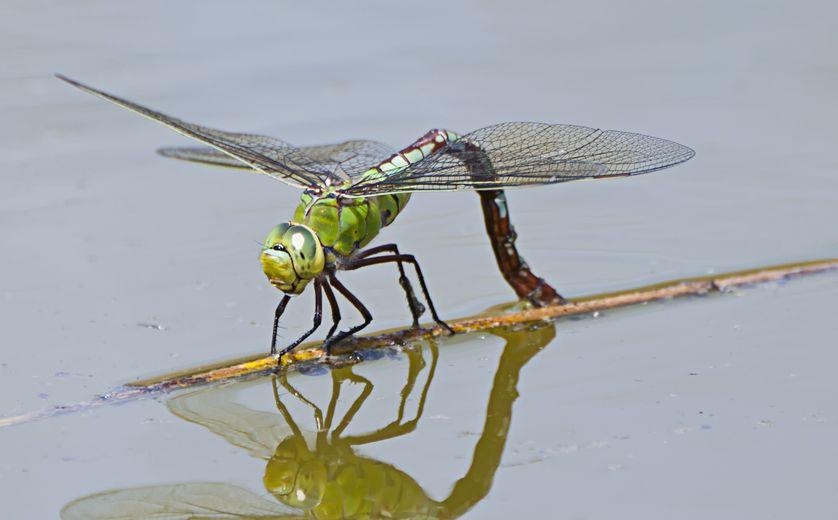
Odonata are amazing insects. They are the best creatures to control mosquitoes and blackflies, provide food for fish and other aquatic creatures, and are great indicators of healthy aquatic systems.
For this reason, I encourage citizen scientists to conduct a survey and compile species lists of Odonatas of the Beaver River watershed. I hope that the information below, from my handbook on the subject, can contribute to this effort.
1. Order and Species
These ancient insects belong to the order of Odonata meaning “toothed ones”. Dragonflies are in the suborder Anisoptera (meaning “unequal wing”). Damselflies are in the suborder Zygoptera (meaning “paired wings”).
Using the 3 6 9 method helps to differentiate between the families and species:
Damselflies have three species: Broadwinged Damsels, Spreadwings and Pond Damsels
Dragonflies have six species: (a) Darners, Clubtails and Spiketails; (b) Cruisers, Emeralds, and Skimmers
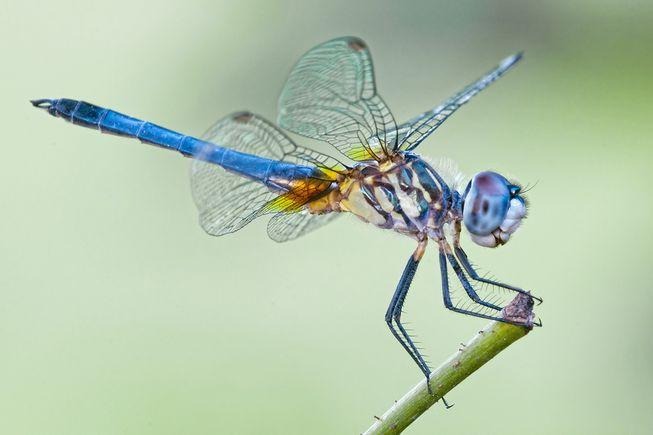
2. Differences between dragonflies and damselflies: Body
Damselflies are generally more slender, having smaller and slimmer bodies than dragonflies.
3. Differences between dragonflies and damselflies: Wings
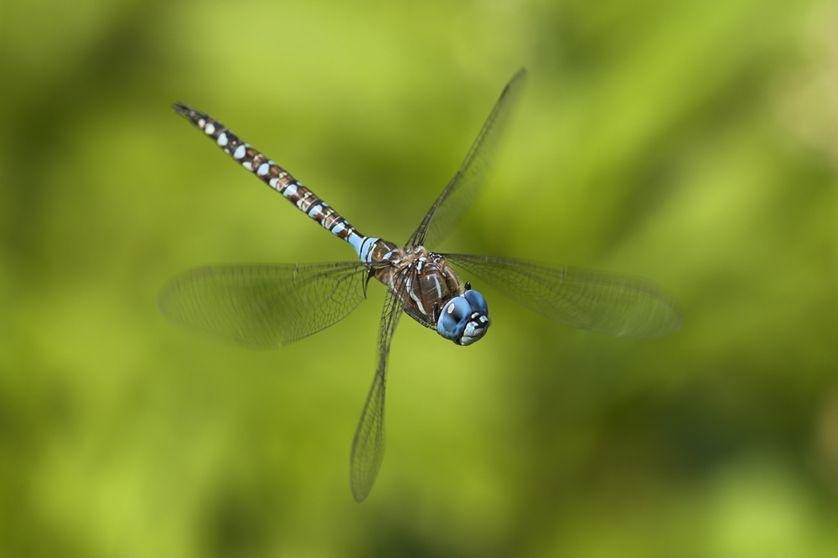
In most damselfly species, their wings are normally folded along the body when at rest, whereas dragonflies hold their wings flat and horizontally.
With damselflies, the forewings and hindwings are similar in size, hence the “paired wing”. A dragonfly’s hind wing is slightly broader than the forewings, hence the “unequal wing”.
The wings also differentiate between dragonfly species. The reinforcement triangles on the hindwing of the (a) group, Darners, Spiketails and Clubtails are similar in both the forewings and hindwings, and are elongated longitudinally along the length of the wing.
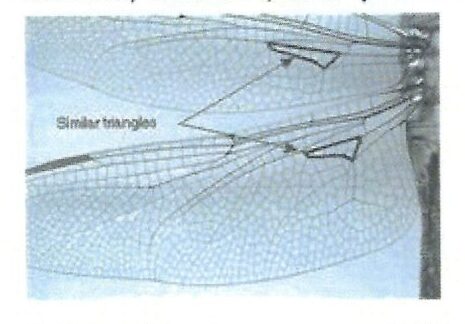
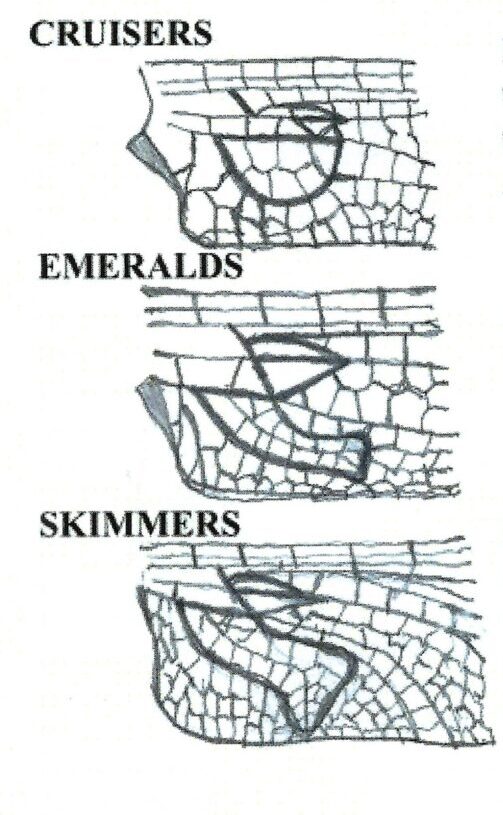
The reinforcement triangles on the hindwing of the (b) group, Cruisers, Emeralds and Skimmers are different from the forewing and are elongated transversely across the wing.
The shape of the anal loop vein in the hindwing in the (b) group is another identifying factor. Shaped like a cup in Cruisers with no midrib, a sack in Emeralds with a midrib and a sock with a heel and toe and midrib in Skimmers.
4. Differences between dragonflies and damselflies: Flight
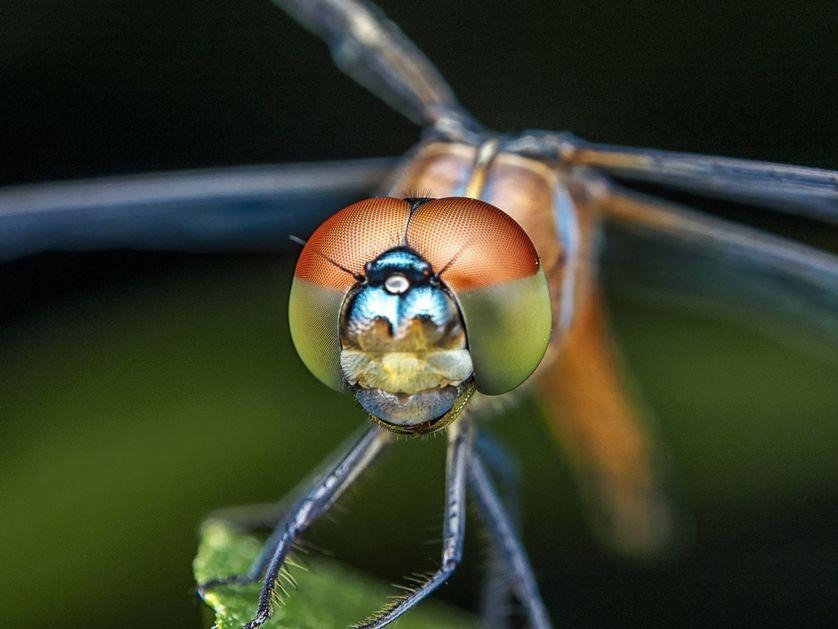
Dragonflies are strong and agile flyers, zipping around flying upside down, backwards, straight up and down, sideways and they can hover.
Damselflies are slower, flitting and fluttering about, having a more graceful appearance when flying.
5. Differences between dragonflies and damselflies: Eyes
Both the damselfly and dragonfly have amazing eyesight with almost 360-degree vision, and one blind spot directly behind them.
The Damselflies’ eyes do not touch. They are set on either side of their head, widely separated much like a hammerhead shark.
Dragonfly eyes, on the other hand, are different depending on species:
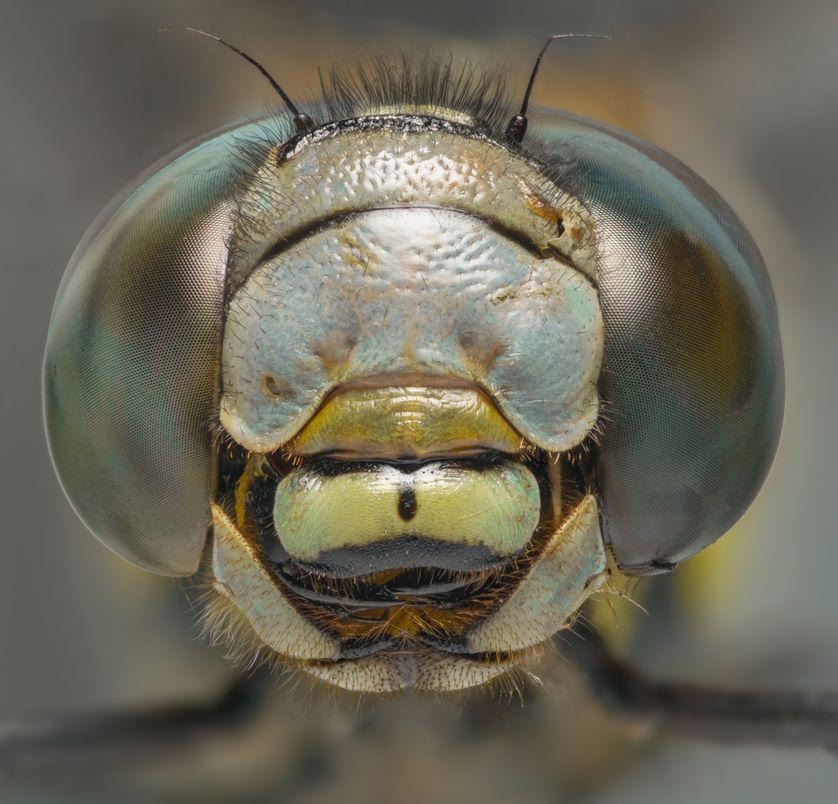
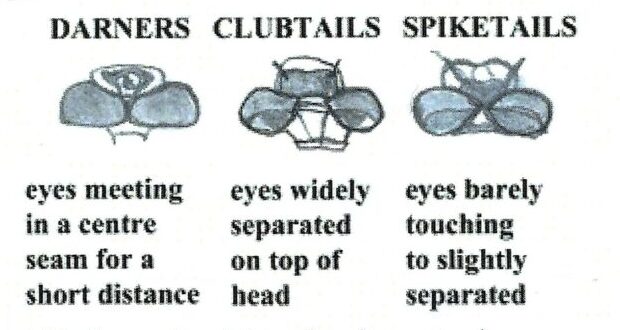
(a) group: Darners have large eyes converging in the middle. Clubtails’ eyes are widely separated. Spiketails’ eyes meet only at one point in the centre.
(b) group: Cruisers’, Emeralds’ and Skimmers’ eyes meet in the middle. The eyes are generally much larger than the damselfly eye.
6. Dragonflies and Damselflies as Environmental Indicators
These amazing creatures serve as indicators, informing us of healthy aquatic ecosystems. Both species need fresh water to complete their life cycle, which includes three stages: egg, larva (nymph) and adult. Each species requires a specific environment for its habitat from ponds, rivers and lakes to slow-moving streams, fast-moving streams and some even prefer marshy areas. As a result, population changes can reveal changes in water drainage, and the presence of certain species can indicate there are no problems in wetland degradation.
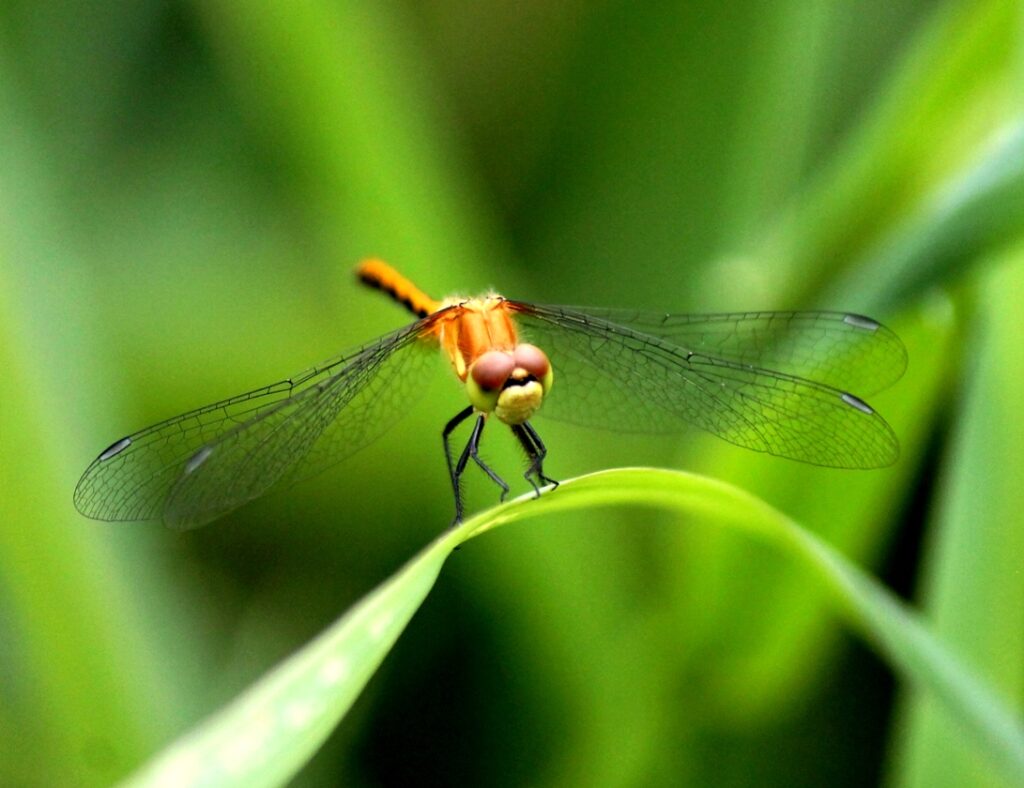
7. The Life Cycle: Egg
The eggs are laid daily over a period of several days and sometimes weeks. Most eggs hatch within 2-5 weeks with a few exceptions the following spring.
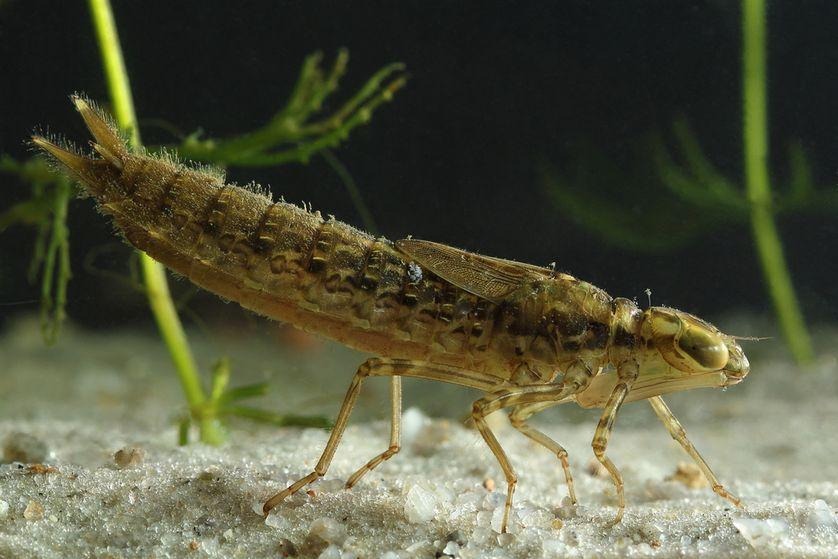
8. The Life Cycle: Larva
The larva live underwater typically for one to two years. There are some species that develop in two to three months and some can take up to five years. At this stage of the life cycle, they are known as nymphs. This is where they spend the majority of their life, underwater. During the nymph cycle, molting or shedding of the skin occurs several times.
9. The Life Cycle: Emergence
The final molt occurs out of the water. This stage is called Emergence. This transition is straight from a larva to an adult. The larva leaves the water to find vegetation where the final molt into adulthood occurs. They redistribute body fluids, pushing the thorax, head, legs and wings out of the larval skin. Their legs harden, after a time, and then the abdomen is detached from the skin. The wings and abdomen, again after some time, expand and harden. Known as tenerals, they are pale and vulnerable to birds, other predators, and heavy rains. Many fish feed highly on damselflies and dragonflies as they emerge from the water.
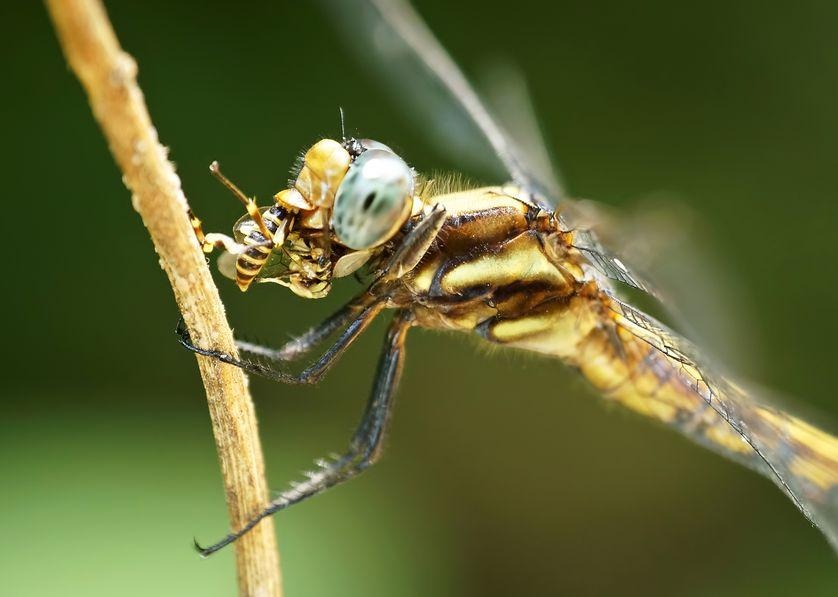
10. The Life Cycle: Adult
It generally takes a few days to obtain adult colouration and sexual maturity. Their life expectancy at this stage is very short, 1-2 weeks for these beautiful insects.
Related posts:
 Late Winter/Early Spring birds
 Citizen Scientists Monitor Plant Sales and Trails for Invasive Species
 From Beaver Valley to the Oyamel Peaks: A Journey to the Heart of the Monarch Migration
 Growing a Resilient Future Using Local Seeds
 Ramping Up for Spring
 Glaciers, Habitat, and Old River Postcards
 E. C. Carr Observatory
 Managing Stormwater as a Watershed Resource
 Fly Fishing on the River
 Local Tree Trust Spotlights Four Old Maples