

In 1853 Sandy Brownlee of Markdale and a friend discovered what they thought was gold at Eugenia Falls. They went back and attempted to extract the sparkling rock secretly, but they were seen and the secret was out. Over the next two weeks about 200 prospectors flocked to Eugenia Falls. They sent samples via runner to Toronto for testing. It took three weeks for the response to come back, so they kept mining. Unfortunately, when word came back, the shiny rock they put their hopes in was shown to be iron pyrite, known commonly as “fool’s gold.”
The village was surveyed by Charles Rankin and William Gilliland. Some young ex- soldiers from the French army who had served in the Crimean War worked on the survey and suggested the name Eugenie for the wife of Napoleon III. Many streets in Eugenia are named for battles fought in the Crimean War.
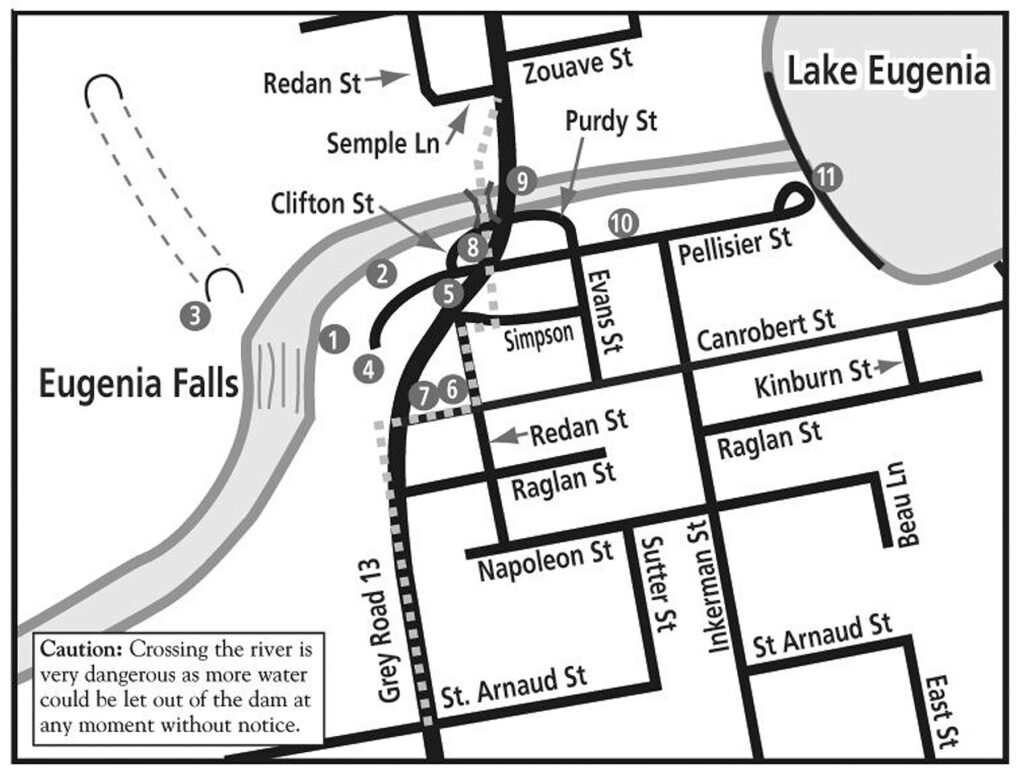
1. Eugenia Falls
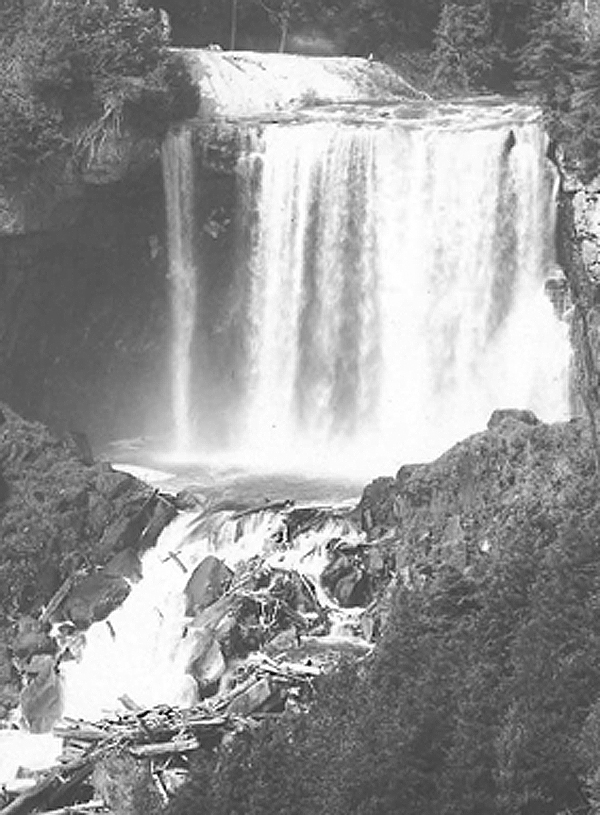
The Indigenous name for the falls was Ke-waid-dun-dot, Sparkling Waters. The first settler to see the falls is said to be a man named Miller,who set out in a group to find the source of a mysterious sound of falling water. When they reached what is now Hogg’s Falls, all but Miller believed that they had found the source of the noise. So he set out alone, until at last he came upon the awe-inspiring falls.
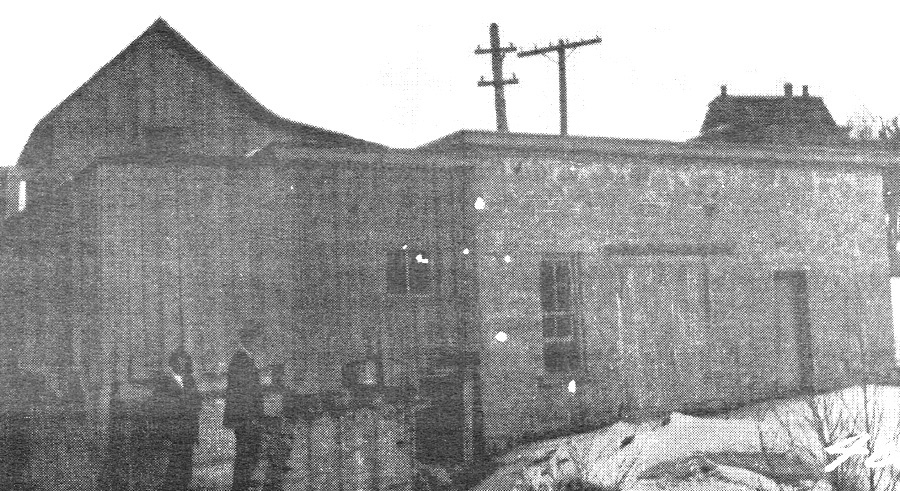
2. William Hogg’s Power Station
William Hogg came to Walterville (Ceylon) in 1870. He had a general store there in 1881, and acted as Post Master. He established a sawmill a few miles from Eugenia at Hogg’s Falls, which burnt in 1888. Impressed by the power at Eugenia Falls, he bought it, as well as some adjoining property, and built a store there in 1889 in partnership with Henry Cairns. By 1895, he had built a small electric plant, which supplied power to Eugenia, Flesherton, and a chopping mill. The plant consisted of a timber crib, dam, timber frame, and a stone power house, which is still standing. Toronto was looking for a source of power for its new streetcar system, and Hogg tried to persuade that his plant would be adequate. But Adam Beck, who was building the Niagara Electric Plant, beat him out. Hogg died around 1900, a broken man.
3. The Tunnel
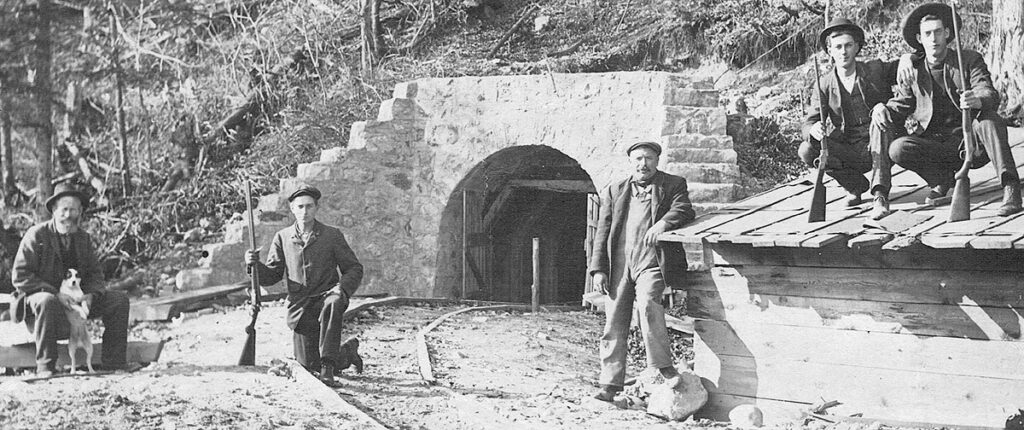
In 1905, a group of Toronto business men formed the Georgian Bay Power Company. Engineers surveyed the river, and planned to divert the river and build a dam across the falls. The river would flow through a tunnel, through the hill next to the falls, out the back of the hill, and down to a power station below. Construction began in 1906, and carried on until the workers hit quicksand. Mr. Butler an experienced miner from England, came to address this problem, and work continued until the tunnel was completed in 1907. The tunnel was 167′ long by 9′ wide by 8’6” tall. Each end was marked by a stone arch. Many people visited and walked through the tunnel, where frigid temperatures existed year-round. But while the tunnel was still under construction, the government’s Hydro Electric Commission was given control of the streams of Ontario, as well as extensive authority of expropriation with the promise of selling power at cost. It became impossible for competing power development to raise capital, and the Georgian Bay Company’s only option was to wait for the Hydro Commission to buy them out. The tunnel was later blown up for safety reasons.
4. The Cenotaph
Mrs. Adam Smith and Mrs. William Wilson, who lost sons over sea, headed a committee to erect a cenotaph in Eugenia Park. Garden parties were held to raise money, and Mr. Borland of Collingwood designed the statue of a soldier standing at attention. The War department donated two canons, and the cenotaph was dedicated in 1921. The ginkgo tree next to the monument is dedicated to Lt. John Allison, MC, who was a second year medical student at the University of Toronto when he enlisted. He was killed in 1918 while flying reconnaissance in Mesopotamia.
5. The Methodist Church
In February,1882, the Methodist Church officially opened. The cream-coloured brick was purchased at Bowler’s brickyard near Markdale, and the church was built by volunteers. Previously, starting in 1874, services were held in the Orange Hall free of charge,. In 1926, the Methodist and Presbyterian congregations joined to became the Eugenia United Church, using the Presbyterian Church building. In 1940, the Methodist Church was torn down so that County Road 13 could be widened.
6. The United Church
The church was built in 1895 as the Presbyterian church. The many Scottish Presbyterian settlers of Eugenia worshipped in their homes until 1876, when they began having services free of charge in the Orange Hall. Land for the construction of a church was donated by J. Robert Hogg, William Hogg’s son. The stones in the foundation contain iron pyrite (fool’s gold).
7. The Orange Hall
In 1862, the settlers of Eugenia formed a lodge, in which membership cost 25 cents. The hall opened on July 1, 1874. All the churches, Presbyterian, Methodist, and Anglican, had services at the hall. It was also used by many organizations for meetings and entertainment. The hall was bricked in 1911, and after the Eugenia school house burned down in 1917, it was used as a school.
8. Eugenia Hotel
The Eugenia House was built in1895. The Victorian style red brick building is located on the main corner of Eugenia. A nephew of Aaron Munshaw Jr., the owner of Munshaw House in Flesherton, Peter Munshaw, was the proprietor. Before the Eugenia House was in operation, Mr. S.T. Halsted ran a hotel, in 1865.
9. Eugenia’s Mills
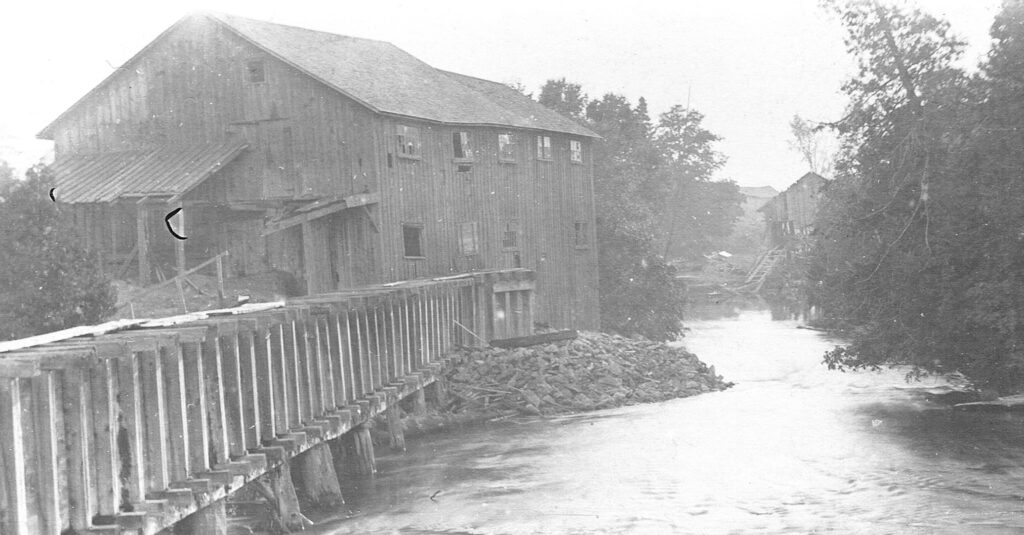
A hoop and veneer mill once stood on the Beaver River in Eugenia. A saw mill was erected in 1859 upstream from the grist mill which was built in 1860, located a short distance from the falls. A quarter mile up the river was a wool factory. The door and sash factory owned by Mr. Sloan also contained a shingle mill and a lathe manufacturing business. Sloan’s mill changed hands several times before being torn down to make way for a wider road and new bridge. The milling operations were seasonal depending on the water levels of the river and demand for products. During a dry spell one summer, all the mills were shut down. Mill dams were made of wood which rotted quickly in the water, and during the spring, the fast moving river put a lot of pressure on them.
10. The Post Office
The Post Office was originally in Robert Purdy’s store on Purdy Street, west of County Road 13 and just outside the gates of the Eugenia Falls Conservation Area. Purdy was the Post Master from 1862-1893. At some point it moved to a location on Pellesier Street, where it remained until its closure in 1969. Locals now use the Flesherton Post Office. The Eugenia public school was on the same street. The original brick school was erected in 1867, and was destroyed by fire in 1917. A new one room school house was erected at the same location, and now serves as a private home.
11. The Hydro Dam
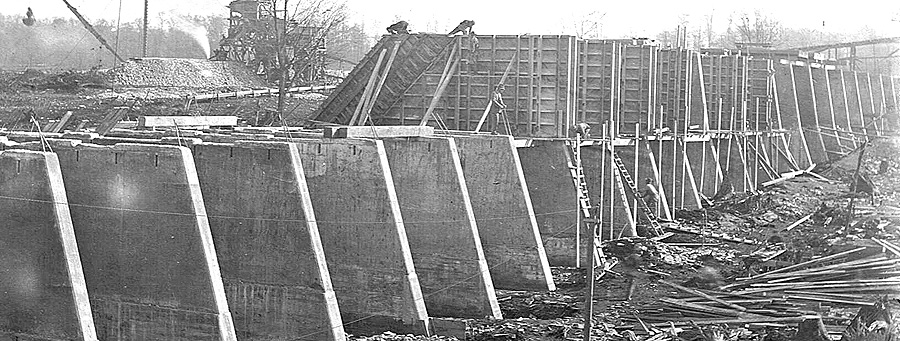
In 1914, The Ontario Hydro Commission bought 1900 acres around the Beaver River. They tore down the remaining mills, and some farm houses were dismantled and moved. About a thousand men came from Italy and Bulgaria to work for 25 cents an hour to build the Power Station and dam. They worked long, hard hours, and there was a huge turnover of workmen. Steam shovels, dinky engines (small train engines), and horses were used, as well as hand labour. The dam was 1700 feet long. One thousand freight car loads of cement and one million yards of cement were used. A wooden stave pipeline with steel strapping 46” in diameter was laid for 3350′ to a surge tank from which a 52” pipe descended for 1557′ to a red brick power plant below. The lake formed became a popular swimming or canoeing location. By 1961, the dam was in a state of disrepair, and Ontario Hydro decided to drain the lake and close the hydro plant. Cottagers, tax payers, and Artemesia Council put pressure on them to instead replace the dam. It was back filled and covered completely, and by the spring of 1962, the water was back at its normal level. In 1999, control of Eugenia Station was transferred from Ontario Hydro to Ontario Power Generation.
12. Dam Number 2
This dam was built in 1914, at the same time as the main dam, by Hyland Construction. It is located at the point where water from the lake enters underground pipes and travels to the surge tanks above the power station.
13. The Surge Tanks 194670 Grey Rd 13
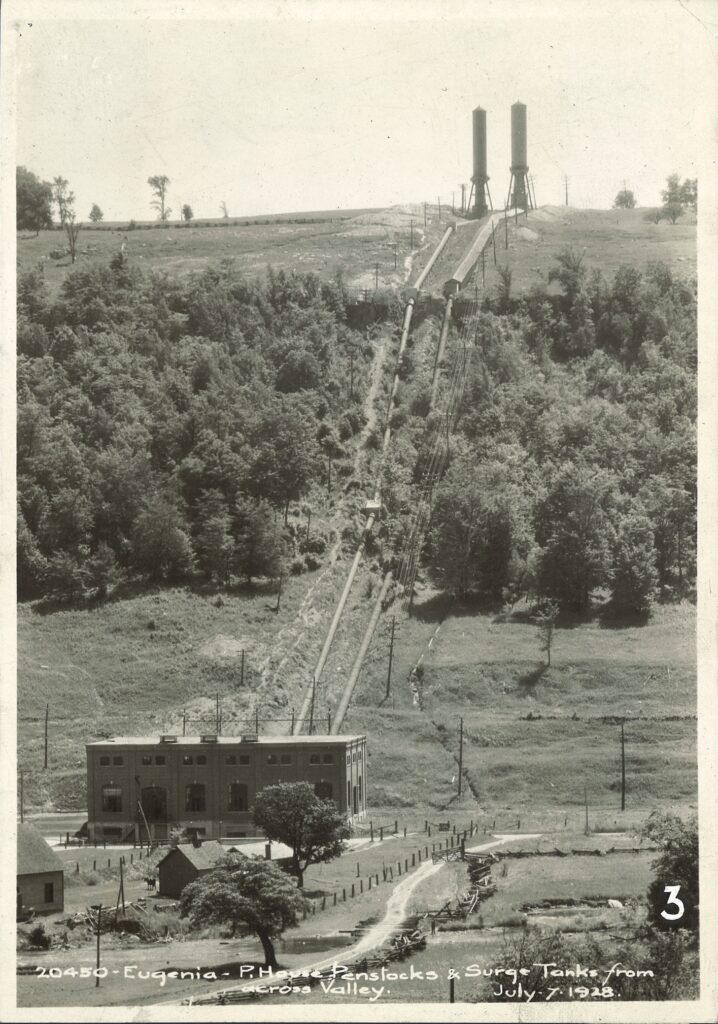
The water travels more than three thousand feet from the lake to the surge tanks, where the water is stored before dropping more than fifteen hundred feet to the Power Station below. The two towers help to regulate the flow of water to the Power Station.
14. The Hydro Plant 174565 Lower Valley Road
The first turbines and generators were ordered from Switzerland, but the ship was sunk by a German U-boat as it entered the St. Lawrence River. Turbine replacements were ordered from Wisconsin and arrived safely at the Ceylon train station. They were hauled to Eugenia by huge sleighs harnessed to eight teams of horses. The transmission system, by 1931, covered the counties of Grey, Bruce and Dufferin; extended into the counties of Huron Wellington, Peel, York, and Simcoe; and was united with the Muskoka and Wasdell’s system to form the Hydro Commission’s Georgian Bay System.
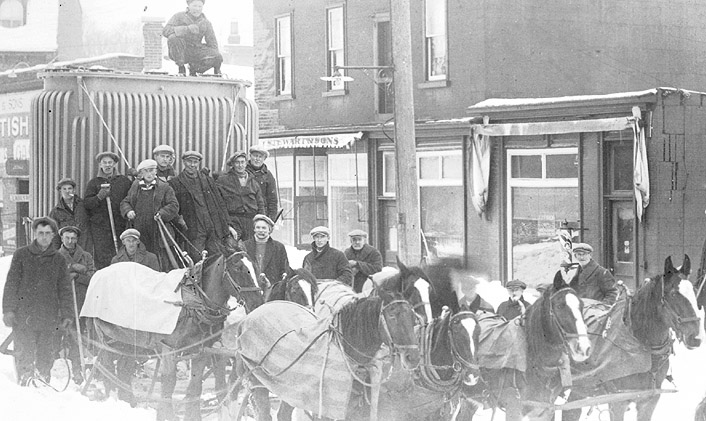
One of the oldest hydro-electric plants still running, it celebrated 100 years of service in 2015.
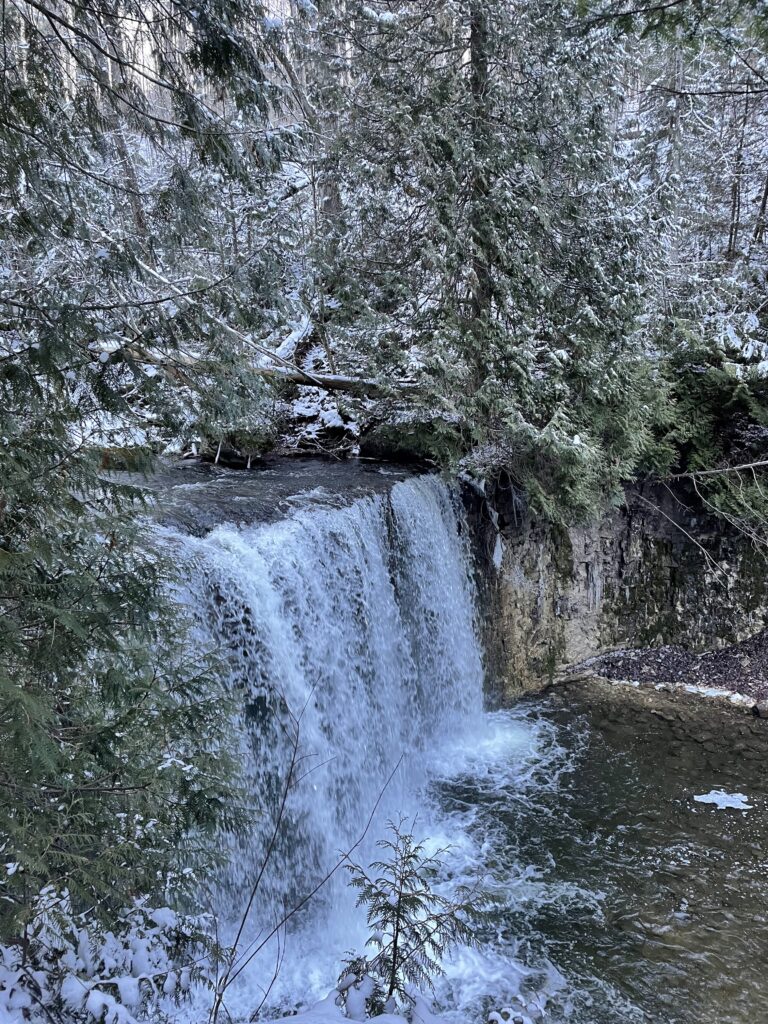
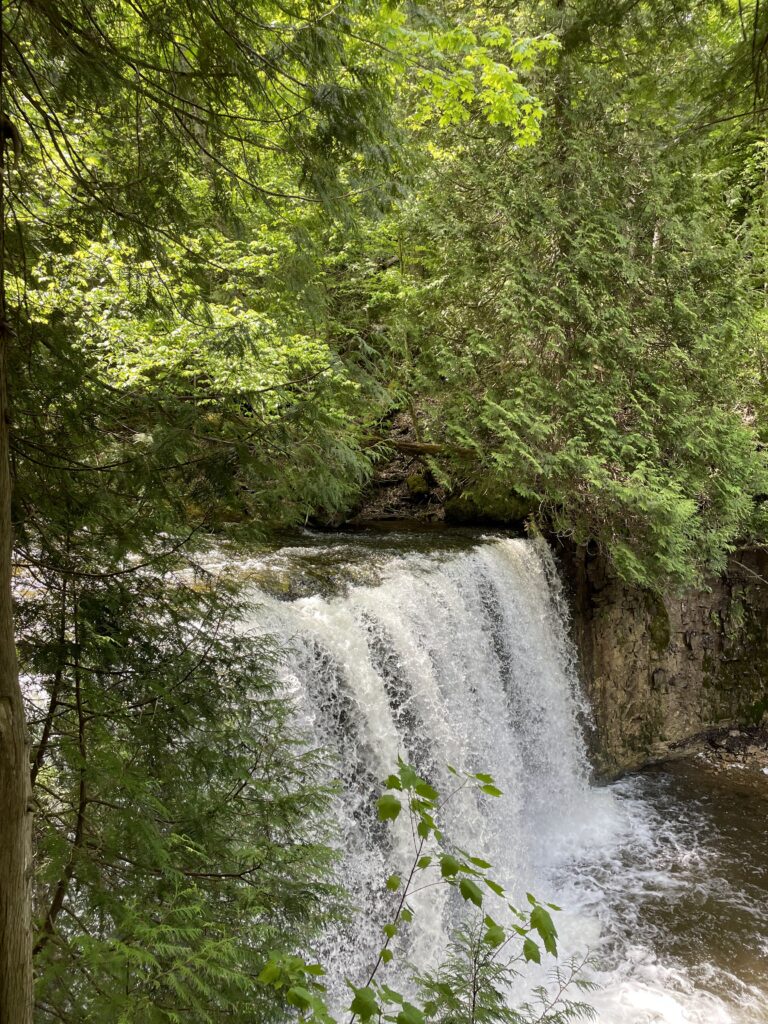
15. Hogg’s Falls 170566 Lower Valley Road
The site of William Hogg’s first mill dam, this waterfall is worth the drive.
Beaver Valley is in the Niagara Escarpment—a UNESCO World Biosphere. Many looping trails of the Bruce Trail are available for hiking: beavervalleybrucetrail.org
This Village Walking Tour is a project of the Grey Highlands Canada 150 Committee. It was prepared in cooperation with Kimberley Community Association volunteers. A special thanks to Marilyn Hammond for her historical knowledge and use of her image collection.
Related posts:
 Priceville Historic Walking Tour
 Kimberley Historic Walking Tour
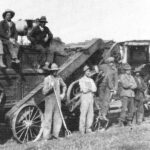 Osprey Historic Walking Tour
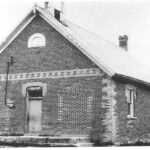 Osprey Township Historic Car Tour
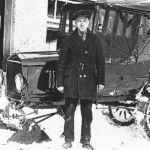 Flesherton Historic Walking Tour
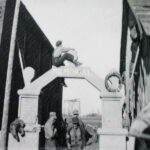 Rocklyn Historic Walking Tour
 Markdale Historic Walking Tour
 Citizen Scientists Monitor Plant Sales and Trails for Invasive Species
 Old Baldy Does Not Exist
 Local Tree Trust Spotlights Four Old Maples