

Some Interesting Facts About Rocklyn
A brickyard was once located beyond the arena.
A cheese factory was operated in Rocklyn by T.A. Pearsal in the late 1800s. It was a thriving business, shipping cheese all the way to Winnipeg. Its location is currently unknown.
Many sawmills operated in the vicinity. Edgar Neely operated a shingle mill. Thomas Gilray operated a sawmill and threshing outfit that threshed a wide area of the town- ship. The last operating sawmill was set up by Austin Ramage in 1970, just north of the village. It operated until 1984.
1. Euphrasia Memorial Centre
This facility was built in 1971–1972, on the grounds of an original Hall built in 1899. In the back, behind the hall, is a stable where skaters stabled their horses on Saturday nights.
2. Memorial Gates

Two memorial stones mark the entryway to the arena. These stones were installed in 1950 between the hall and the arena to remember Euphrasia Township men who served in the First and Second World Wars. The Memorial Gates were placed at the entrance to the Rocklyn Fairgrounds before the new hall and arena were built.
3. Community Barn Quilt
The patchwork of the Rocklyn Community Quilt on the side of Euphrasia Memorial Centre expresses community spirit. On the 16 quilt blocks are 12 different community groups which use the arena or hall regularly, including The Centre Grey Lions
Club, Rocklyn Country Theatre, Rocklyn 4H Clubs, Temple Hill United Church and the local Women’s Institute.
4. Rocklyn Inn
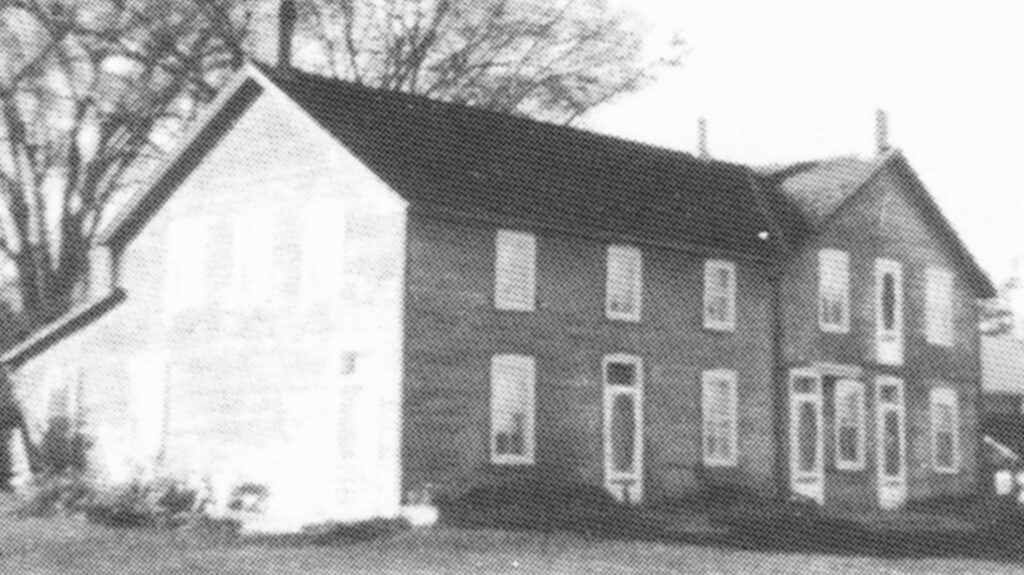
The original inn was 4 built in 1881 by W.H. Dodson, who named it after the Marquis of Lorne, then Canada’s Governor General. Dodson was a merchant, postmaster, marriage license issuer, valuator and money lender. In 1891, lightning burned down the hotel. It was rebuilt on the same site. It was used as a post office and butcher shop. This photo is the Lorne Hotel in 1966. It was a busy hotel , with 13 bedrooms, a dining room and a bar for the men and a sitting room upstairs for ladies.
5. Blacksmith Shop
The blacksmith shop stood on the southwest corner of the village in the 1870s. It was built by Donald McArthur. The building was sold a number of times and was relocated by “Watt” McCullough in 1905. In 1931, Andrew McGirr bought McCullough shop, becoming Rocklyn’s last and longest-serving blacksmith.
6. Post Office
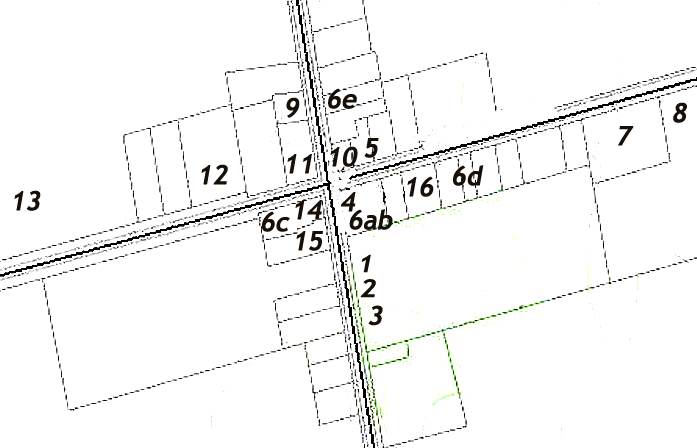
Rocklyn was named by the post office naming department which had an aversion to long names. The post office was established in 1875, with Postmaster John Perrett running it out of his store (6a) until it burned down in 1891. It then moved to Dodson Hotel (6b) until 1896; to J.E. Richards’s store (6c) until 1945, Harold Adams’ home (6d) until 1965 and Emerson Cook’s (6e) until July of 1970.
7. Smith’s Garage
This business was located next to the township offices for several years before moving to Meaford, where it operated until 1955. The building was torn down in 1970, replaced by a family home.
8. The Chopping Mill
Presently used by the Georgian Heights Church, this site was originally home to a chopping mill run until early 1956. That building was torn down in 1966 and replaced with the Euphrasia Municipal Building in 1967.
9. Euphrasia’s Second Township Hall
This hall opened in 1886 after the first Township Hall burned down. It served the township for the next 80 years until 1967, when the offices moved to the Chopping Mill site (see #8). It is now a private residence.
10. The Manse
This building was formerly Rocklyn’s only bank, known as Molson’s Bank. It was purchased by the Temple Hill Charge in 1955 from Mrs. Thomas Gilray.
11. Rocklyn General Store
This success story operated well into the 20th century. The general store began as the Rossin House in 1857 and later operated as the Rocklyn Hotel. In 1870, it became the first local establishment licensed to sell spirits. From 1888 to 1892 a store was operated in the old Rocklyn Hotel based on a cooperative model of business.
12. Mel Wonch’s Garage
This site was built on in 1959 by Robert Wonch. Mel Wonch purchased it in 1964, building a house on the site and adding an upstairs to the garage. He added a hoist and paved the yard. He was a mechanic, operated a tow truck and sold vehicles.
13. Maple Sweet Retreat
In 2014, this local building became Maple Sweet Retreat, a facility providing group accommodations for up to 16 people. It began as the Rocklyn Academy, a pri- vate school for teenaged girls, which operated between 1998 and 2010.
14. Roy Thompson Store
At one time, there were three stores operating in the village. This particular store was built by J.E. Richards in 1898, who sold it to George Crabtree. George’s daughter Freda operated a millinery shop above the store. He disposed of the business in 1911. It was widely known in its later years as the Roy Thompson Store.
15. Butcher Shop
This private residence was once a barbershop and before that a butcher shop. Originally, the Orange Hall stood on this
site before being torn down to make way for the butcher shop.
16. Doctor’s House
Many doctors served the community over the years. Dr. Bennett served the community from 1891. He was followed by Dr. Danard, Dr. Williams and Dr. Leach. In 1923, Dr. Carefoot established himself in Rocklyn, but later moved to Markdale where he was instrumental in starting the first hospital there.
Take a short drive to the Temple Hill Church 136371 9th Line or the Epping Lookout at 196241 Grey Road 7.
This Village Walking Tour is a project of the Grey Highlands municipal Canada 150 Committee. It was prepared in cooperation with the Friends of Rocklyn and the Rocklyn Agricultural Society and Centre Grey Lions Club volunteers. Special thanks to the Women’s Institute’s Tweedmuir book.
Related posts:
 Priceville Historic Walking Tour
 Osprey Historic Walking Tour
 Markdale Historic Walking Tour
 Kimberley Historic Walking Tour
 Osprey Township Historic Car Tour
 Eugenia Historic Walking Tour
 Flesherton Historic Walking Tour
 Local Tree Trust Spotlights Four Old Maples
 The Geology of the Beaver Valley
 The Wickens Family in Kimberley, 1857 and on