

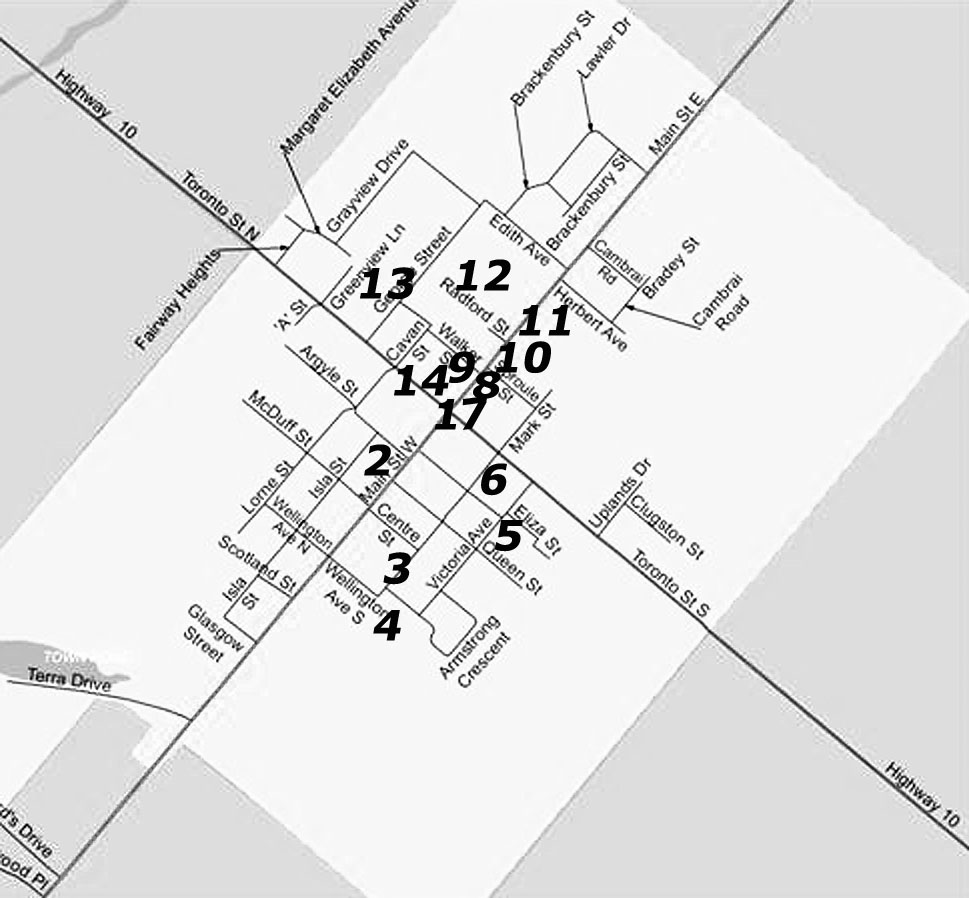
Originally named Cornabuss, the first settler here was George Walker in 1849.
The Grey and Bruce railway was enticed to town in 1871 with bonuses and land given by Mark Armstrong Sr. for a station—so the stop and later the town was named after him—the tracks reached town Dec. 21, 1872.
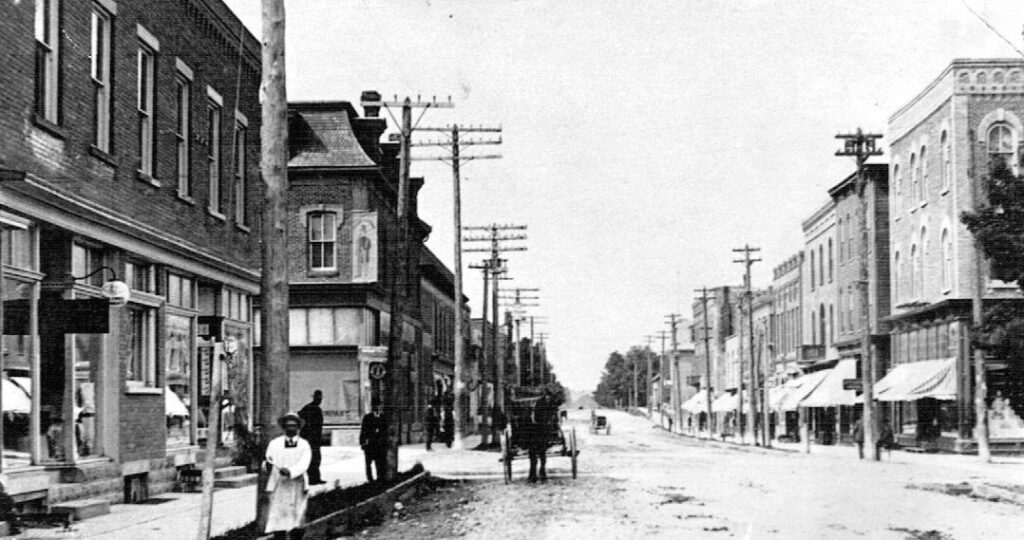
1. Main crossroads 1860s
The intersection was a lively place for commerce in the mid-1800s. Brown and McKnight’s general store was on the southeast corner. In 1864, Thomas Mathews moved in just south of them, operating a successful saddle and harness-making shop. W.J. McFarlane opened a general store on the southwest corner in 1862. It became a major business in Ontario, being the first local merchant to light his premises with gas, replacing coal oil lamps in 1884. Solomon Hill arrived in 1863 and built a similar store on the northwest corner. Thus began a local rivalry lasting well into the early 1900s.
2. 12 Argyle Street North
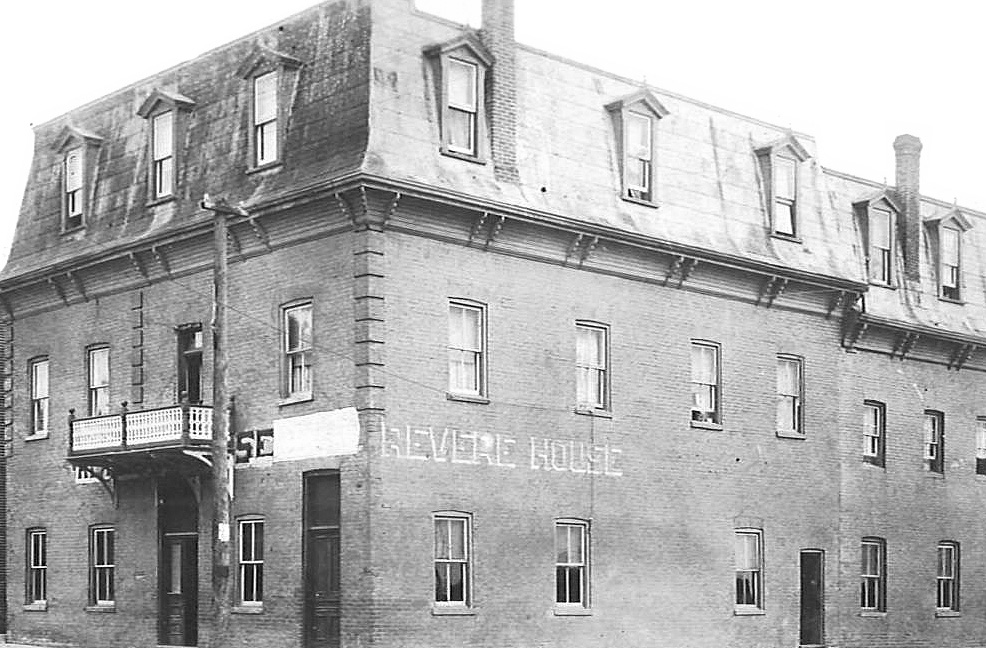
The Centre Grey hospital is a 14-bed facility with 24-hour emergency service. This is also the site of the Revere Hotel, which was used as a hospital in its later years. It was a three-story brick building with large stylish bedrooms and well-stocked bars. In the 1880s, you could stay there for $1 a day.
3. Mark’s Maples
In 1884, early settler Mark Armstrong, opened 20 new lots in the town and planted 150 young maple trees along the limits, lining both sides of Mark Street from Queen Street to the east, Wellington Street to the west and Mill Street to the north. Today their size tell their age.
4. 150 Mark Street
This home was built for Mark Armstrong Jr. in 1892. The red brick for this and many Markdale houses was made in Cheeseville, east of town, at the Bowler Brick Works. Mark Jr. built this house on land gifted from his uncle Mark, for whom Markdale is named. He and his brothers established a sawmill and local factories. In 1906 they provided the quarter-cut flooring for Buckingham Palace.
5. 55 Victoria Avenue
Victoria Street at Eliza is the site of the original Markdale Public School, built in 1895, it was torn town in 1985. In 1987, the location was marked by a carillon constructed of its original red brick and topped with the now-missing school bell.
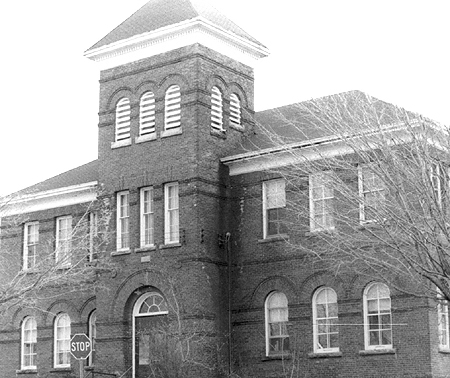
6. 66 Toronto Street South
Solomon Hill, built what is known as Hill House in 1896. One of first settlers in the area, he was a local merchant for 47 years. He built one of the finest Queen Anne revival style houses in small-town Ontario.
7. 21 Main Street East
This stately building was built with the last run of the Bowler bricks in 1914. Erected with Carnegie funds, this is one of 125 Carnegie Libraries in Canada and served as a free public library until 2011. The library then moved into a new building in the King Edward Park area. Since then the original building has been home to local businesses
8. 25 Main Street East
This house, built in 1868 by Thomas Mathews, was the first brick house built in Markdale made of Bowler bricks.
9. 26 Main Street East
Now the home of the Markdale Veterinary Clinic, this building, built in 1949, was originally a service garage. It was considered one of the best in this part of Ontario. It had space for an office, a showroom and a garage workshop.
10. 63 Main Street East
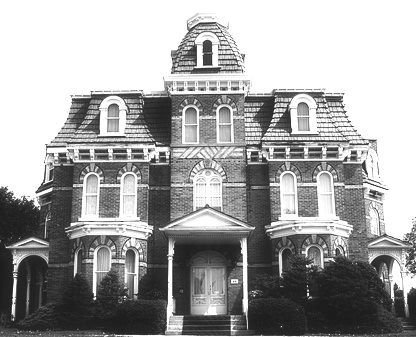
Knarsboro Hall was built circa 1881 by Dr. Thomas Simpson Sproule, who hired a Toronto architect to design the hall after a Scottish mansion of the same name. The 22 round-headed windows each boast a different flower of Scotland. Dr. Sproule was known for his political endeavours. He served under seven prime ministers—many as Speaker of the House.
11. 81 Main Street East
The George Haskett family built this house around 1895. They turned it into a social centre for the community. The vacant house was Markdale’s “haunted house” from 1963 to 1970.
12. 75 Walker Street
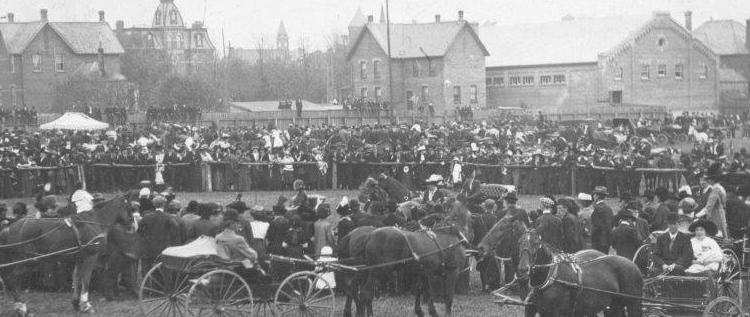
King Edward Park was officially opened in September 1905, after Markdale council purchased the 10-acre site for $1,400 to host the local agricultural fair, horse races and other athletic pursuits. The first Glenelg Agricultural Society’s fall fair was held there the next month.
13. 42 George Street
This residence, one of Markdale’s first, was built in the late 1870s in the Victorian style with a touch of Gothic and Greek.
14. 19 Toronto Street North
This 1913 building was originally a two-storey fire hall with a hose-drying tower and fire bell. A new fire hall was built in
town in 1995. The mural shows the original Markdale train station.
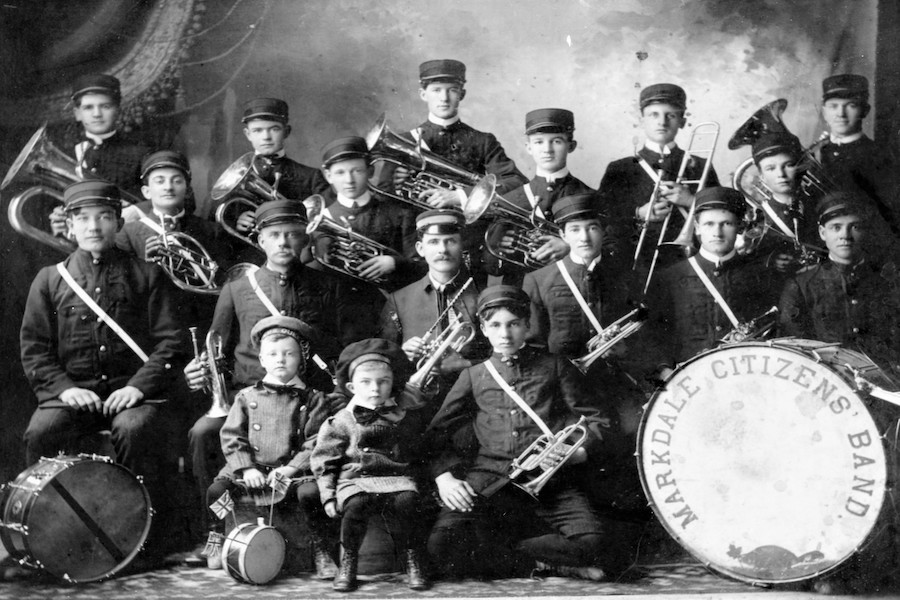
This Village Walking Tour is a project of the Grey Highlands Canada 150 Committee. It was prepared and launched in cooperation with local volunteers on the Markdale Recreation Committee and the Markdale Agricultural Society. Special thanks to Sherman Wood for his local knowledge. For more details see Markdale: The Crossroads of Grey.
Related posts:
 Osprey Historic Walking Tour
 Rocklyn Historic Walking Tour
 Kimberley Historic Walking Tour
 Osprey Township Historic Car Tour
 Flesherton Historic Walking Tour
 Priceville Historic Walking Tour
 Eugenia Historic Walking Tour
 Old Baldy Does Not Exist
 Local Tree Trust Spotlights Four Old Maples
 The Wickens Family in Kimberley, 1857 and on